Wednesday, November 18, 2009

Roasting a chicken

I have long been an admirer of Jan Roberts-Dominguez, who writes a food column for the Mail Tribune. I find her commentary to be insightful and her recipes both creative and accessible. But a couple of weeks ago – October 28, to be exact - she surprised me (in a bad way) with this article on “The ‘perfect’ roasted chicken.” You can click on the link and read it yourself, but I’ll just summarize here: In search of a moist and flavorful chicken, Jan consults two of her favorite go-to cookbooks, The New Best Recipe and Cookwise, quickly discovering that their definition of simplicity does not match her own. Jan reprints The Best Recipe instructions with the title “'Easy’ Roast Chicken”; quote marks on “easy” suggesting that it’s not.

Well. I love roast chicken, and it’s true that you can just stick it in the oven and wait until it’s done. That’s easy. But as Jan and her favorite cookbook authors have found, the result can be disappointing. So if you want a really good roast chicken you’re just going to have to put in a little more effort. Jan says that the entry on roast chicken in the Best Recipe book was FOUR PAGES (her caps) long, but so is just about every recipe in the book. The beauty of that cookbook is the explanation of what they tried and what worked and what didn’t and why. I love that about it (as I have said in the past, I am a geek that way). The recipe itself is not complex, fitting nicely in a little four inch square on the newspaper page. Maybe I am seriously out of touch, but I cannot see what isn’t easy about this method. You salt and pepper the chicken and brush it with melted butter. You roast it on its side 20 minutes, turn to the other side for 20 minutes, and then turn it breast-side up until done. How hard is that?

The recipe I use is from Julia Child’s Mastering the Art of French Cooking, but it’s very similar to the Best Recipe one. Julia’s recipe goes on for several pages as well, but that’s only because she explains everything in such detail. Who would have wanted her to leave out the bit about how to tell when the chicken is done: “A sudden rain of splutter in the oven, a swelling of the breast and slight puff of the skin, the drumstick is tender when pressed and can be moved in its socket.” Captures it pretty well, I'd say.

Anyway, Julia instructs you to start roasting the chicken in a hot oven first to brown it, then lower the temperature to finish cooking. Like the Best Recipe folks, she has you turn the chicken a couple of times during cooking. This is essential if you want the breast meat to be juicy, and Julia’s got a couple of extra turns to promote even browning.

Here’s a summary:

Start with a 4 lb chicken. Preheat oven to 425. Rinse chicken, dry it, salt inside, and smear outside with 2 T softened butter. Put chicken breast-up in a V-rack in a roasting pan and put it in the oven. From now on, every time you open the oven to turn the chicken, baste it quickly, starting with another 2 T melted butter mixed with 1 T cooking oil. After 5 minutes turn it on its side. After 5 more minutes turn it on its other side. After 5 more minutes reduce heat to 350. 30 minutes later, put it back on its other side. After 15 more minutes turn it breast side up, and roast for another 15 minutes. Check for doneness as instructed above; it may need up to 15 more minutes.

Okay, maybe that sounds like a lot of fussing. But you're probably in the kitchen anyway, peeling potatoes and trimming green beans and washing lettuce, and all you have to do is brush the chicken a couple of times and turn it over when the timer beeps. This is not hard. I promise.

Julia also has us add vegetables to the pan to flavor the juices for the gravy you’ll surely want to make. I don’t do that, but instead roast the chicken with a stalk of celery, a half a carrot, and a quarter onion in the cavity. I also don’t truss the bird – I don’t think it makes all that much difference and feel vindicated that Best Recipe doesn’t include this step. I use the pan drippings afterwards to make a milk gravy, because that’s what Alekka wants on her mashed potatoes.

The other very important point is to start with a good chicken. I like the organic Smart Chickens that the co-op sells; I have also bought nice ones from Bickle Family Farms. Pretty soon, I’m hoping, we’ll be raising our own. The factory farm chickens from the supermarket surely are cheap when they are on sale and they are fine for making stock, but I think they have an off taste that’s sort of medicinal when roasted plain. (I don’t really want to know what that taste is but I just picked up a copy of Jonathan Safran Foer’s new book Eating Animals so I suppose I will soon find out).

Yes, I know this is a duck, not a chicken, but I like the picture. It’s the cover of magazine Andreas picked up for me at the Paris airport. The article (as well as I can tell with my limited French) is about the those crazy Americans and their fascination with French cooking despite its reliance on fat, salt and so on. That’s Meryl Streep as Julia Child in "Julie and Julia," in case by some fluke you missed the movie.

Thursday, November 12, 2009

When the frost is on the punkin…


...you’d best hurry up and pick it before it freezes and turns to mush.

In years past our garden has produced enough pumpkins for friends and neighbors to pick their jack-o-lanterns from our backyard patch, but this year the vines weren’t very prolific. Fortunately we did grow enough for Thanksgiving pie and a bit more besides.

Some people are afraid of pumpkins, I think. Maybe it’s the thick skin or the goopy seeds. But don’t be intimidated. If you didn’t grow any yourself, you can likely find them at a farmer’s market or at the co-op. Look for small “baking” or “sugar” pumpkins – the big Halloween varieties are mostly gone to the great compost heap in the sky, but they aren’t much good for eating anyway.

Once you’ve acquired your pumpkin, you’ll want to cut it in quarters or halves (a big chef’s knife should do the trick) and put the pieces cut-side down on a baking sheet. Don’t worry about the seeds – we’ll take care of those later, after the baking. Put the baking sheet in the oven at 300 degrees and bake for at least an hour. When a fork goes in easily, they’re done. I have read that if your pumpkin is too hard to cut, you can just put the whole thing in the oven or microwave for a few minutes to soften it before cutting. Personally, I believe that this would work in the oven, but I would be wary of the microwave unless you’ve poked some good holes in the skin first. A pumpkin explosion would be messy indeed.

After it’s baked, let the pieces cool a little, then use a spoon to gently scrape away the fibrous strings and the seeds. Then scrape the flesh away from the skin or just pull the skin off with your fingers. You can mash the pumpkin flesh or do like I do and whir it around in the Cuisinart. Then it’s recipe-ready, and what you don’t use now you can freeze for later. It may not be quite as easy as opening a can of Libby’s but it is homemade and organic.

I’ve accumulated quite a few pumpkin recipes thanks to bumper crop years – pumpkin soup, pumpkin stew, pumpkin bread, pumpkin cookies… the list goes on. This weekend I dug out the final container of last year’s frozen pumpkin to make this recipe, a standby from the 1985 Sunset cookbook Cookies . They’re called “bars”, but in my opinion, they’re cake. Whatever they are, the recipe is ideal for when it’s Sunday morning and you just remembered it’s your turn to bring coffee goodies to church.

Pumpkin Bars

4 eggs
¾ C canola oil
2 C sugar
2 C cooked pumpkin
2 C flour
2 t ground cinnamon
¾ t each ginger, cloves, and nutmeg
¾ t salt
2 t baking powder
1 t baking soda

In a large bowl of an electric mixer, beat eggs lightly; beat in oil, sugar, and pumpkin. In another bowl, stir in together flour, cinnamon, ginger, cloves, nutmeg, salt, baking powder, and baking soda; gradually add to pumpkin mixture, blending thoroughly.
Pour batter into a greased and flour-dusted 10 by 15 inch baking pan. Bake in a 350 degree oven for about 35 minutes or until edges begin to pull away from the pan and center springs back when lightly touched. Let cool in pan on rack.

The original recipe also has an orange cream frosting topped with almonds that is quite superfluous. Without it they will still be the hit of coffee hour; I guarantee you, those Unitarians will scarf them down faster than they can say “multicultural peaceful spiritual renewable organic solar diversity.”

Sunday, November 8, 2009

Tattie lifting

This was the weekend for tattie lifting. No, I didn’t buy a new bra, silly (cross my heart.) Tattie lifting is when you dig the potatoes out of the ground.

It’s really more fun than you might think. You rummage around in the dirt with your hands and come up with big beautiful potatoes. Leave the spade in the shed or you'll just wind up with hash.
Tattie lifting is great for getting in touch with one’s Scottish roots (Scottish tubers?). Being a little bit Scottish myself, I once spent an autumn in the tiny village of Nethy Bridge in the Highlands, where kids got days off from school to participate in the potato harvest. As I recall, it looked like they were having a good time of it. (Here is where I wanted to insert a video of Ewan MacColl singing "The Tattie-Lifter's Song" but it seems no such video exists on YouTube. You can hear a little bit of the song here on Amazon... track 15... perhaps a little bit goes far enough).

We had a good time, too.


Alekka and her friend Suzie were excited about digging up the buried treasure.

We had forgotten which plants were which, and potato plants all look pretty much the same above the ground. When all was done, the garden yielded a big box of lovely russets, red skinned potatoes, and yellow fingerlings.

In case you're wondering why anyone would bother growing potatoes when they can get a ten pound bag for two dollars at Safeway, you might feel differently after tasting the fresh ones. Homegrown potatoes actually do have a flavor - earthy - and an excellent texture.

Check out this fine example from our garden, just before it was scrubbed, baked, and served up steaming at the dinner table – great chieftain of the tattie race!

Saturday, November 7, 2009

Scary and sweet


Hey folks, I’m back. I took a little detour from blogging into fiction writing after my good buddy Jenni convinced me to sign up for NaNoWriMo, but I have already fallen off that particular wagon. Evidently I will not be composing the Great American Novel this month (you can all exhale now).

I realize that not posting since September has probably cost me my loyal readership - all three of you. I will try to win you back by posting twice this weekend. Let’s start with the Halloween post I didn’t write.

Halloween: a time for spooky stuff, and candy too.

Which brings us to my daughter Alice. Scary and sweet. Alice learned to wring the necks of chickens while living in a beach shack in Mexico and now has a chicken skeleton tattooed on her arm, in memoriam. Alice makes gourmet meals for unemployed friends out of stuff she finds in dumpsters. Alice clipped articles on the Italian olive oil industry out of magazines for me by candlelight in the back of the moldy van that used to be her home (probably one of the few homeless people with a subscription to the New Yorker). But these are all topics for other posts.

Our princess in army boots came to visit for the weekend (she lives in Eugene now, in an actual house). Alice is great fun in the kitchen and, as usual, we traded some new recipes and cooked up a couple of terrific dinners together. Then, the morning before she left, Alice popped a batch of bacon into the oven and took her brother and sister on a walking field trip to… Donut Country.

We have the fortune – good or bad, I’m not sure – to live a few short blocks from one of the best sources of fried dough in the region. If you live in East Medford, you will be able to deduce by the absence of cars lined up for the drive-though around back that I took this picture in the afternoon; also missing is the crowd of white-haired retirees in search of a window booth intermingled with tweens stopping by the counter on their way to Hedrick Middle School up the street. Mornings are pretty busy here in Donut Country.

So anyway, on this particular morning, Alice and Nik and Alekka returned from their excursion with a bag of freshly frosted maple bars. Alice took the bacon out of the oven and laid it in strips on top of each maple bar, and before my aghast eyes, the kids proceeded to consume them. Alice tells us she learned about this, um, dish on a recent road trip to Portland, where she and her friends feasted on Bacon Maple bars at Voodoo Donuts.

After watching the frightening spectacle for a few minutes, I got up the nerve to try it myself. And what do you know, it was pretty good – a lot like pancakes with maple syrup and bacon. So good, in fact, that I pledge to stop in at Voodoo Donuts when I’m in Portland next weekend so I can compare with the original. I’ll be reporting back with my findings.


On the sweet and scary bacon theme, here’s something I’ll bet you didn’t find in your trick-or-treat bag this year.


It's a chocolate bar with bacon bits. You can get them at Lillie Belle Farms Artisan Chocolates in Central Point. Our boy Dimitri picked this one up for me… come to think of it, maybe he's a little sweet and scary as well. Must run in the family.

Saturday, September 12, 2009

The very best thing ever to do with tomatoes


First thing this morning I spent a little time in the vegetable garden, hand watering the areas not served by drip lines. Usually Andreas does this but as he is in Greece for two weeks the job falls to me. I'm actually enjoying getting out there in the early hours of the day. This morning I brought in some squash, several cucumbers, and another big bowl of tomatoes, in addition to my favorite summer morning treat, squash blossoms.

Breakfast today was an omelet made with the blossoms, some herbs from the garden and a couple of local eggs. It was my intention to have our own chickens by now, but the coop-construction plans got sidetracked this summer in favor of a bedroom redecoration and a few other home improvement projects. We still hope to have it done before next spring, as we've promised Alekka some baby chicks. Fortunately local eggs aren't hard to come by.

After breakfast Alekka and I headed out to Ashland to shop at the co-op and to check out the Eat Local kick-off celebration in front of the store. They had a bluegrass band and some purist-friendly food samples. The Eat Local organizers had a table and I made my participation official by signing up. They are sticking to the standards, these THRIVE folks, and I guess that's a good thing - although it means I don't get to call myself a Purist. Coffee drinkers may as well turn in their badges right now. Oh well, been there, done that. So this year I am an Idealist.

The bar is pretty low for Idealists: all you have to do is eat one meal a day that is all-local. That's too easy. I intend to keep to my own Powdermilk Biscuit standard ("pure... mostly"; also "tasty" but not necessarily "expeditious"). However, after checking out the bulk food section at the co-op I think I will write myself a couple of more exceptions. I thought I remembered that Black Ranch wheat (sold at the co-op) had a white flour but it seems they don't. So I'm going to allow myself my usual white flour from Bob's Red Mill, located about 30 miles outside the 200-mile zone; the wheat itself is grown mainly in Idaho. And I'm going to use that Napa Valley red wine vinegar our son brought up last year. It will make a better vinaigrette than lemon juice does.

So, you might ask, why can't I manage without flour? After all, it's only a week. This is why - it's to make the bread that goes so well with with the amazing tomato stuff. You lightly toast a slice of rustic bread, spread it with with goat cheese (made locally by Siskiyou Goat Dairy or Mama Terra, from Ashland Food Co-op) and top it with these roasted tomatoes dripping in garlicky olive oil. Last night I wasn't allowing myself the bread because the wheat wasn't local, so I put some of the tomatoes on my steak. That was good, too.

One day last summer Nik ate an entire batch of these tomatoes in a day, so last night I secured the bowl from midnight snackers with rubber bands and a "do not eat" sign to make sure there would be some left for tonight. By the way, when the tomatoes are gone, don't throw away the oil - use it to make dressing, to cook eggs in, or for dipping more bread.

Pomodori al Forno

1 C olive oil, divided
2 lbs. plum tomatoes, halved lengthwise, seeded
1 1/2 t dried oregano
3/4 t sugar *
1/2 t salt
1 or 2 garlic cloves, minced
2 t minced Italian parsley

*Eat Local people - it will be fine if you omit the sugar

Preheat oven to 250 degrees. Pour 1/2 C oil into a 13x9 glass baking dish. Arrange tomatoes in the dish, cut side up. Drizzle with remaining 1/2 C oil. Sprinkle with oregano, salt, and sugar. Bake 1 hour. Use tongs to turn the tomatoes over. Bake another hour. Turn tomatoes again. Bake until deep red and very tender, about another 15 to 45 minutes.
Layer tomatoes in a bowl or glass loaf pan, sprinkling garlic and parsley over each layer. Pour the liquid from the baking dish into a large measuring cup. Pour just the oil that rises to the top of the measuring cup (not the tomato liquid) over the tomatoes until they are covered (if there is not enough baking oil, use additional olive oil). Let stand at room temperature 2 hours. Serve with goat cheese and toasted bread slices.

Friday, September 11, 2009

Mapping out a week of Eating Local

Today is the first day of my third year of the Eat Local Challenge and I’m feeling confident. The first year, I was a self-described “stickler” who made no exceptions whatsoever to the 100-mile rule. One of the things I learned from that experience was that I need exceptions. My second year, last year, I wrote a blog about my week of eating local for the Mail Tribune. We had some great meals that week and I found several new sources for local ingredients. This year will have a few new twists.

The rules themselves have changed for 2009: “local” according to the sponsor's rules, is now defined as “grown, raised, or produced within the 200 mile radius.” I assume this change was effected to include the coast with its fishing industry and also seawater (for salt) from Port Orford. Well, 200 miles is all right by me. I love fish and now I won’t have to write myself an exception for salt. But I don’t like the “grown, raised, or produced” part – I like to keep it to grown or raised. “Produced” means the ingredients could come from anywhere; this might be good for the local economy but if you are concerned about food miles I think you need to look at where all the individual components come from.

I got out a map and tried to make a geometry lesson out of the new local definition but my 12 year old daughter wasn’t having any of it. It’s been a rough first week at school for us both. So I drew the circle myself: it arcs the coast from Lincoln City OR to Fort Bragg CA. Heading up I-5 it reaches just north of Salem to Keizer, and south as far as Willows CA. Heading due east we go past Lakeview to an area called the Basque Hills. Ought to be plenty to eat in that big circle.

As I mentioned, work has been a bit of a trial recently. In fact, I didn’t get to the Ashland food co-op this week at all and so started the challenge today somewhat unprepared. But we’re doing OK. There were nice local 49er peaches (from Quality Market) for breakfast. Lunch was some eggplant salad made according to a recipe in a previous post with all-local ingredients (except the oil - see below), some leftover steamed green beans from our garden, a carrot bought last week at the co-op, and some raspberries also from the garden. I was hungry when I got home so I ate the leftover garden chard that was in the fridge.

I had to dig around in the freezer a little to find dinner for me and Alekka. I bought a quarter beef from rancher Larry Martin in Central Point a while back - one of the big changes in my food purchasing habits that came about because of last year's Challenge was that now we get almost all of our meat now from local producers - but now most of it is gone except for some short ribs and stew meat. I have an order in for a half beef but the animal won't be killed until October.

But then I found a package of long strips of round steak down in the bottom of the case and thawed it out in the microwave after work.For dinner I cooked that on my stove-top grill along with some Romano beans from the garden – they’re great tossed with some olive oil before grilling and sprinkled with salt and a little lemon after. Alas, no local potatoes in the house but I’ve got a loaf of bread baking in the oven (no local flour in the bin, so the bread will just be for the kids). That and some of our amazing baked tomato stuff (more about that tomorrow) and I think the two of us are all set for decent - and local - meal.

I call myself a purist but I have to make a couple of exceptions if I want get to the goal of educating myself with local eating lessons I can use throughout the year. I don't see this as a Lenten-like deprivation exercise, rather as an opportunity to open my mind to the to realities of agribusiness while exposing my tastebuds to nearby epicurean delights. That's how I interpret it anyway. I could survive a week on steamed zucchini and raw tomatoes from the garden but that wouldn’t inspire me to any kind of higher level. So –

1) I get to drink coffee. The first year I did the challenge, I gave up coffee (it doesn’t grow here) but got a mongo headache that didn’t go away all week. I haven’t done anything to cure myself of my addiction so there we are. Anything that goes into the coffee, however, must be local.

2) Cultures. So many tasty foods depend on yeast and bacteria that I’m just not going to worry about where those ingredients came from. That means I get to make yeast bread (with local flour, of course). I suppose maybe for next year I could get a starter going and make sourdough bread out of the air. But meanwhile for our purposes I declare that yeast is not a food. Same with bacterial cultures used to make buttermilk, sour cream, cheese, and so on. I would not be able to partake of the delicious local cheeses or even make my own if I worried about where the starter was made (the one I use comes mail order from Vermont, but I don’t know where they get it). Even Daisy brand sour cream whose sole ingredient is listed as “cultured cream” contains bacteria of unknown origin. Same with sulfites added to wine and other similar trace chemicals. I say, who cares.

3) Olive oil. My son is allergic to all dairy products, but aside from butter, there are no local oils. You have to have some oil for cooking, and if I choose butter for its local-ness, I have to cook a second dinner for my son without it. No thanks. Besides which, olive oil is delicious and good for you. I get mine in bulk at the food co-op in a container I reuse, so at least I can say I save on the packaging.

4) Lemon juice. I need something sour to make salad dressing and to add a little tang to things. The other option is vinegar. Last year one of our sons in California had the grace and good sense to bring a bottle of Napa Valley red wine vinegar with him on a visit during Eat Local week and I talked myself in to thinking that was legit. But I think we need a real exception. The lemon juice is from lemons we picked ourselves on a visit to LA but I can’t honestly say that makes them local-legal – that’s a slippery slope (I mean, where are the food miles savings if I fly to Ecuador to satisfy a banana craving?)

So, those are my rules. Tomorrow I'm going shopping.

Wednesday, September 9, 2009

Off he goes, in to the wild Blue Zone

Andrea has gone to Greece for two weeks. He and his brother Tony and their uncle Andy are flying today from Athens into the little airport at Faros on Ikaria. This is something I hope to never do. For one thing, the airport at Faro makes the Medford International Airport look like LAX. Please note in the photo how the runway ends at a little cliff above the sea. And who, I ask, would willingly board a dinky plane headed for an island named after a guy who fell out of the sky and into the waves? There is even a big statue of Icarus in front of the airport (you can sort of see it in the picture). Aristotle would call this hubris. I would say take the boat. Aack.

Andreas is going to Ikaria with his uncle Andy so they can sort out the family property there. They need to get it surveyed and registered with the authorities so it doesn’t end up belonging to the guy storing lumber in the old kafeneo or the other guy who’s using one of the houses as a goat shed. Andreas is also (we hope) finalizing his paperwork to become a Greek citizen. We shall see.


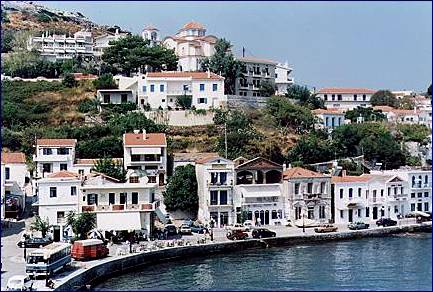
Evdilos

The travelers aren't actually staying in their own village, which is called Arethousa. Instead they're staying nearby in the larger port town of Evdilos. Andreas's aunt called from Athens last week to warn them not to stay in Arethousa because two guys there want to kill Uncle Andy. Eighty-year-old Uncle Andy hasn't been to the island for thirty years but he seems to inspire that kind of thing in people. Andreas emailed me to say that Uncle Andy nearly caused an international incident at Orly airport last week when the French customs officer got a little too personal.

Ikaria recently found itself in the limelight once again after being identified as a “Blue Zone”, one of those places where people live to remarkable ages. Here’s a short video about it. Apparently there's a best selling book about this Blue Zone thing. It was even on NPR. For those of you who have a lame computer like mine and can’t watch the video, these are the “eight simple secrets” of becoming a very old Ikarian:

1) wild greens
2) herbal teas
3) low sense of time urgency
4) daily naps
5) mountain living
6) strong sense of community
7) goat milk
8) Ikarian diet (more vegetables, beans, olive oil; less meat & sugar. Not so much fish and grains, but plenty of potatoes.)